

Every new match in fantasy cricket presents a fresh opportunity to test your skills, refine your strategies, and compete for prizes. Whether you're a seasoned fantasy cricket player or just beginning your journey, approaching each new match with a structured methodology can significantly improve your performance. Understanding how to evaluate playing conditions, analyze player form, and build balanced teams separates successful fantasy cricket enthusiasts from casual participants. This comprehensive guide explores proven strategies for maximizing your potential whenever a new match appears on the schedule.
Understanding the New Match Landscape
When a new match gets added to the fantasy cricket calendar, the first 24-48 hours represent a critical window for research and preparation. Early preparation allows you to study team announcements, weather forecasts, and pitch reports before the majority of participants begin their analysis. Fantasy cricket platforms typically release new match contests several days in advance, giving strategic players ample time to conduct thorough research.
The competitive landscape changes with each new match based on several factors. Tournament context matters significantly-a knockout match produces different player approaches than a league stage game. Team combinations shift based on injuries, rotation policies, and strategic decisions by management. Recent form trajectories influence player selection, but savvy fantasy cricket participants also consider historical performance at specific venues.

Key Research Areas for Every New Match
Before finalizing your fantasy team for a new match, comprehensive research across multiple dimensions provides the foundation for informed decisions:
- Pitch and venue characteristics that favor batsmen, bowlers, or balanced performances
- Head-to-head statistics between competing teams at the specific ground
- Recent form analysis covering the last 5-10 matches for key players
- Team news updates regarding injuries, rest rotations, and lineup changes
- Weather forecasts that might impact match duration or playing conditions
Building a systematic research routine ensures you don't overlook critical information. Googly11 India Fantasy Cricket Guides offers detailed match previews that consolidate this research, helping you make data-driven decisions faster. The platform provides player analysis and team selection tips specifically tailored to upcoming matches.
Historical data reveals patterns that repeat across seasons. According to research on statistical evolution in ODI cricket, performance trends at specific venues remain remarkably consistent over time. Players who excel at certain grounds often continue that success in subsequent matches at the same location.
Team Building Strategies for a New Match
Constructing an optimal fantasy team for a new match requires balancing several competing priorities. Your budget allocation must distribute resources efficiently while securing premium players who consistently deliver points. Captain and vice-captain selections carry double importance, as their points multiply your potential returns.
Budget Allocation Framework
| Player Category | Recommended Budget % | Strategy Focus |
|---|---|---|
| Premium Batsmen | 30-35% | Anchor selections, consistent scorers |
| All-rounders | 25-30% | Value picks, multiple point streams |
| Bowlers | 20-25% | Wicket-takers, economy specialists |
| Differential Picks | 15-20% | Low ownership, high upside players |
The new match environment often presents opportunities to identify undervalued players. When teams announce unexpected changes to batting order or bowling roles, quick-thinking fantasy participants can capitalize before ownership percentages rise. Monitoring official team announcements and press conferences provides early intelligence that shapes winning lineups.
Creating multiple team variations allows you to test different strategic approaches. Some fantasy cricket enthusiasts build conservative teams with proven performers, while others construct aggressive lineups featuring high-risk, high-reward selections. Tournament structure influences this decision-head-to-head contests reward consistency, while large-field tournaments favor differentiation.
Player Role Optimization
Understanding player roles within their actual cricket teams directly impacts fantasy point potential. Opening batsmen receive more opportunities to score runs, while death bowlers face high-pressure situations that either yield wickets or expensive overs. The fantasy cricket team builder helps optimize role selection by analyzing each player's specific responsibilities.
Recent match outcomes demonstrate role importance clearly. The thrilling MLC 2025 clash showcased how opening batsmen who capitalize on powerplay conditions can single-handedly determine fantasy outcomes. Similarly, analyzing the SA20 2025-26 opening match reveals patterns about how players perform in pressure situations.
Advanced Analytics for New Match Selection
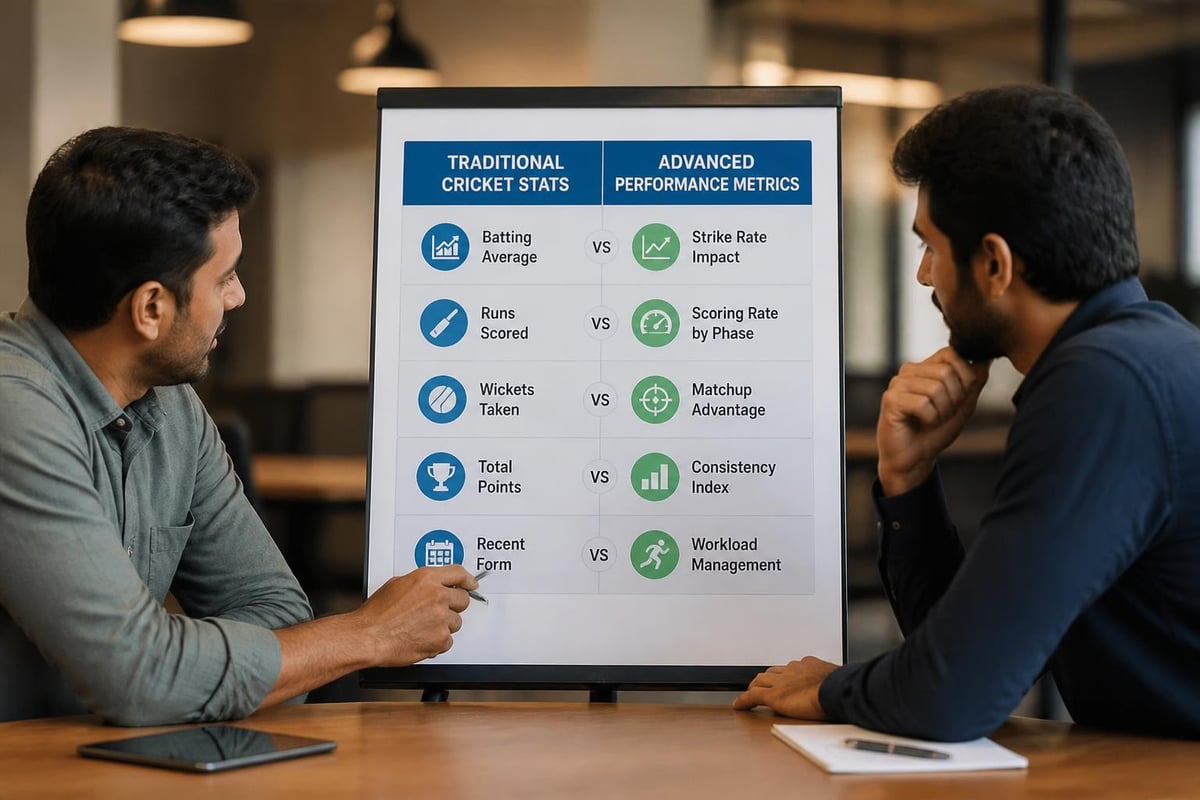
Modern fantasy cricket success increasingly depends on sophisticated analytical approaches. Traditional statistics like batting average and bowling economy remain relevant, but advanced metrics provide deeper insights into player value and consistency.
The CAMP framework for cricket performance evaluation introduces context-aware metrics that account for match situations, opposition quality, and environmental factors. Applying these principles to new match selection helps identify players positioned to outperform their ownership percentages.
Data Points That Matter Most
- Strike rate trends in powerplay versus middle overs versus death overs
- Boundary percentage indicating aggressive intent and scoring efficiency
- Dot ball percentage for bowlers showing control and pressure creation
- Impact performances in similar match contexts and conditions
- Consistency scores measuring reliable point production across matches
When evaluating a new match, cross-referencing multiple data sources validates your selections. The Asia Cup 2025 dataset analysis demonstrates how structured data evaluation reveals non-obvious patterns that influence match outcomes. Fantasy cricket participants who incorporate these analytical approaches gain measurable advantages over competitors relying solely on intuition.
Tracking live match statistics during games also improves future new match decisions. Understanding how quickly players adapt to conditions, how captains deploy bowling resources, and which batsmen accelerate at specific stages builds pattern recognition that applies to subsequent matches.
Contest Selection and Entry Strategy
Choosing appropriate contests for each new match represents an often-overlooked strategic dimension. Fantasy cricket platforms offer various contest types, from small head-to-head matchups to massive guaranteed prize pool tournaments. Your team construction should align with contest format and competitive dynamics.
Smaller contests (2-10 participants) reward solid, balanced team selections. Since fewer entries compete for prizes, minimizing risk through proven performers often succeeds. These contests suit players who prefer consistent, incremental growth rather than high-variance outcomes.
Medium-sized contests (50-500 participants) balance risk and reward. Winning requires both quality player selection and some strategic differentiation from popular choices. Identifying 1-2 low-ownership players who you believe will outperform expectations provides the edge needed to reach prize positions.
Large-field tournaments (1,000+ participants) demand contrarian thinking. Top prize positions typically require multiple differential picks that significantly outperform while maintaining enough stability to avoid complete failure. These contests attract players comfortable with higher variance in exchange for larger potential returns.
| Contest Type | Team Strategy | Captain Selection | Risk Level |
|---|---|---|---|
| Head-to-Head | Balanced, safe picks | Popular, proven performers | Low |
| Small League | Quality over differentiation | Mix popular and differential | Low-Medium |
| Medium Tournament | 1-2 contrarian picks | Semi-differential options | Medium |
| Large GPP | 3-4 unique selections | High-risk, high-reward | High |
For comprehensive guidance on fantasy cricket strategies, experienced players recommend diversifying across contest types. Allocating your budget across multiple entry points reduces the impact of a single poor performance while maintaining upside exposure.

Pre-Match Preparation Checklist
Systematic preparation before each new match eliminates rushed decisions and oversight errors. Creating a standardized checklist ensures consistent execution regardless of external time pressures or distractions.
48 Hours Before the New Match
- Review official team announcements and expected playing XIs
- Analyze pitch reports and historical scoring patterns at the venue
- Check weather forecasts for potential rain interruptions
- Identify players returning from injury or entering the lineup
- Research recent form including domestic and international performances
24 Hours Before the New Match
- Monitor any last-minute team news or lineup changes
- Finalize captain and vice-captain selections based on updated information
- Create backup team options for different contest types
- Set price alerts for target players experiencing ownership shifts
- Review opposition strategies and likely player matchups
Match Day Preparation
The hours immediately before a new match begins require final adjustments based on breaking news. Toss results significantly impact player value-teams batting first provide certainty for batsmen, while chasing scenarios favor adaptable all-rounders. Following reliable sources like live cricket score platforms ensures you receive real-time updates that inform last-minute decisions.
Experienced fantasy cricket players maintain flexibility until lineups lock. If a key player gets unexpectedly rested or conditions change dramatically, quick adjustments prevent wasted roster spots. The fantasy tips section provides match-specific insights that help navigate these dynamic situations.
Managing Multiple New Matches Simultaneously
Peak cricket seasons often feature multiple new matches scheduled on the same day across different tournaments. Successfully managing parallel contests requires organizational systems and strategic prioritization.
Tournament prioritization should reflect your knowledge depth and resource availability. Focus intensive research efforts on tournaments where you possess competitive advantages-perhaps following specific teams closely or understanding unique playing conditions. For secondary tournaments, leverage community insights and expert analyses to inform quicker decisions.
Time management becomes critical when juggling several new matches. Allocating specific research windows for each match prevents analysis paralysis while ensuring adequate preparation. Some successful fantasy cricket participants use templated research frameworks that standardize information gathering across all matches.
Budget allocation across multiple new matches also deserves consideration. Spreading your total investment across several contests reduces exposure to any single match's variance. This diversification strategy mirrors portfolio management principles-limiting downside while maintaining upside participation.
Multi-Match Strategy Framework
- Primary focus matches: 60% of research time, highest budget allocation
- Secondary matches: 30% of time, moderate investment
- Tertiary opportunities: 10% of time, minimal entries for variance reduction
The IPL 2026 coverage demonstrates how major tournaments command focused attention while smaller series receive proportionally less emphasis. Adjusting your approach based on tournament significance optimizes return on your limited time investment.
Learning from Each New Match Outcome
Post-match analysis transforms individual contests into long-term skill development. Reviewing which selections succeeded, which failed, and why builds pattern recognition that improves future new match performance.
Tracking performance metrics across matches reveals personal tendencies and biases. Do you consistently overvalue certain player types? Does recency bias cause you to overweight recent performances while ignoring broader trends? Systematic tracking exposes these patterns, enabling conscious correction.
Creating a performance journal documenting your selection rationale proves invaluable. When reviewing past new matches, understanding your decision-making process-not just outcomes-separates lucky wins from skill-based success. This reflection practice accelerates learning curves and prevents repeating preventable mistakes.
Successful fantasy cricket participants also study winning teams from completed matches. Analyzing which player combinations and strategic approaches topped leaderboards provides blueprint inspiration for future contests. The winners section showcases strategies employed by top performers, offering educational insights beyond generic advice.
Player Ownership Dynamics in New Matches
Understanding how ownership percentages evolve for each new match creates strategic opportunities. When premium players carry extremely high ownership, their fantasy value diminishes-even strong performances may not differentiate your team from competitors.
Leverage points emerge when quality players carry surprisingly low ownership due to recent poor form, tough matchups, or public perception issues. Identifying these situations before ownership stabilizes can provide significant competitive edges. Historical analysis shows that fading public opinion on temporarily struggling stars who face favorable conditions produces excellent risk-reward profiles.
Ownership strategy should align with contest type, as discussed earlier. In large-field tournaments, avoiding chalk plays (extremely popular selections) becomes essential for reaching top positions. Conversely, smaller contests reward quality over differentiation, making popular players more viable.
Ownership Categories and Strategic Responses
- Ultra-high ownership (40%+): Avoid in large tournaments, acceptable in small contests
- High ownership (25-40%): Evaluate carefully based on upside and contest type
- Medium ownership (10-25%): Often optimal balance of quality and differentiation
- Low ownership (5-10%): Potential leverage plays if fundamentals support selection
- Ultra-low ownership (<5%): High-risk tournament plays only
Monitoring ownership trends as new matches approach reveals market sentiment and potential inefficiencies. If public perception significantly diverges from your analytical conclusions, these gaps represent either correction opportunities or signals to reassess your assumptions.
Adapting to Different Match Formats
Each cricket format-Test matches, ODIs, T20s-presents distinct fantasy cricket dynamics. Strategies optimized for one format often fail when applied to others. Understanding these differences ensures appropriate adjustments for every new match regardless of format.
T20 matches emphasize explosive performances and role specialization. Powerplay specialists, death bowlers, and big-hitting finishers carry premium value. Match volatility runs high, as individual performances swing dramatically based on brief momentum shifts. Captain selections should favor players with multiple point-scoring pathways-batsmen who also bowl occasionally or bowlers with batting capabilities.
ODI cricket balances consistency with match-winning performances. The extended format allows players more opportunities to build innings or take wickets across 50 overs. All-rounders provide exceptional value given their dual contribution potential throughout longer matches. The player performance analysis highlights format-specific strengths that inform selection decisions.
Test cricket fantasy (where offered) requires entirely different evaluation frameworks. Consistency across multiple days matters more than explosive single-session performances. Opening batsmen and pace bowlers who extract movement from fresh pitches carry elevated importance. Evaluating team strategies regarding declarations and follow-ons adds complexity absent from limited-overs formats.
Psychological Aspects of New Match Participation
Mental discipline separates long-term successful fantasy cricket participants from those who experience inconsistent results. Each new match tests your ability to remain objective, avoid emotional decisions, and maintain strategic consistency regardless of recent outcomes.
Recency bias represents the most common psychological trap. A player's last performance disproportionately influences perception, causing overreaction to small sample sizes. Maintaining broader perspective by reviewing 10-15 match histories provides more reliable insight than fixating on the most recent game.
Confirmation bias leads participants to selectively emphasize information supporting pre-existing beliefs while dismissing contradictory evidence. When researching a new match, actively seek data that challenges your initial assumptions. This intellectual honesty improves decision quality even when it contradicts your preferences.
Emotional detachment from individual matches prevents tilt-the state where frustration from losses drives increasingly poor decisions. Viewing fantasy cricket participation as a long-term portfolio rather than individual bets maintains healthy perspective. Variance ensures that even optimal strategies produce losing outcomes in specific matches; process quality matters more than single-match results.
Setting predetermined budgets and adhering to disciplined bankroll management prevents emotional decisions driven by recent wins or losses. The responsible play guidelines outline healthy approaches that sustain long-term participation while avoiding problematic patterns.
Technology and Tools for New Match Success
Modern fantasy cricket success increasingly relies on technological tools that streamline research, automate calculations, and provide analytical insights unavailable through manual analysis alone.
Points calculators help project fantasy scoring potential based on historical performance patterns and expected match conditions. The fantasy points calculator enables quick scenario modeling, testing how different player combinations might perform under various match situations.
Statistical databases aggregate comprehensive cricket data, making historical research efficient and thorough. Rather than manually reviewing scorecards across multiple seasons, these tools instantly surface relevant patterns and trends. Integration with fantasy platforms allows seamless player evaluation without toggling between multiple websites.
Community platforms and social media channels provide collective intelligence that individual research cannot match. Following expert analysts, reading match preview discussions, and observing market sentiment supplements personal analysis with diverse perspectives. However, maintaining independent judgment prevents groupthink and ensures you capitalize on market inefficiencies.
Automated alerts notify you of breaking team news, lineup changes, and other critical developments affecting new match preparation. Timely information access provides advantages in competitive environments where minutes matter for optimal selection.
Approaching each new match with systematic preparation, analytical rigor, and strategic discipline transforms fantasy cricket from casual entertainment into a skill-based competition where informed participants consistently outperform the field. By implementing the research frameworks, team-building strategies, and psychological approaches outlined above, you position yourself for sustainable success across seasons. Ready to put these strategies into practice? Googly11 provides the tools, insights, and contests you need to compete confidently in every new match, turning your cricket knowledge into tangible results through carefully constructed fantasy teams.